


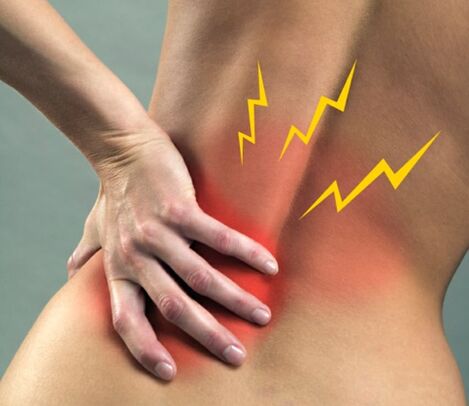
According to world statistics, about 80% of the adult inhabitants of our vast planet have the same health problem - periodic or even constant back pain in the lumbar region.Low back pain is the main symptom of many diseases of the spine and internal organs located in the abdominal cavity.And it is completely in vain that the majority of people who feel discomfort in this area, bypassing the doctor and, without understanding the reason, begin to use various ointments and other "homemade lotions".With these methods, you can easily achieve the opposite of what you expected.
Reason: identify, eliminate
The success of any treatment depends directly on the accuracy of the diagnosis;As symptoms are eliminated, the likelihood of recurrence increases.Then such treatment can only make the situation worse.Therefore, first of all, you need to carefully examine the condition of all organs, the symptom may be pain in the lumbar region.
Digestive system
Exacerbations of diseases of the digestive system (pancreatitis, ulcers, colitis, cholecystitis, enteritis, appendicitis) often cause pain in the lumbar region.
Urinary system
Often, kidney pain is confused with symptoms of lumbar spine disease, because their nature is identical.Diseases of the kidneys and urinary tract of various causes are not only accompanied by "twitching" in the lower back, but also with urinary disorders (frequent urination, discomfort, blood in urine and turbidity) and increased body temperature.
Reproductive system
With problems with reproductive organs in men and women in the acute stage, pain often spreads to the lumbar region, coccyx or to the side.The nature of these pains is often diffuse without clear localization.
If any disease of an organ not related to the musculoskeletal system is detected, it is a disease that needs to be treated, because this is the real cause of the pain syndrome.If after a thorough examination no problems are identified with the above organs, it is likely that there is a problem with the spine.
Osteoarthritis
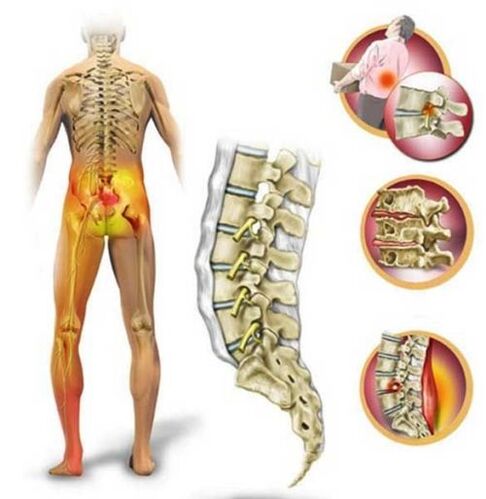
The most mobile part of the spine, which bears the lion's share of the load, is the lumbosacral part.With a sedentary lifestyle, excessive loads and insufficient supply of nutrients to the cartilage tissue of the spine, degenerative-dystrophic changes in the cartilage between the vertebrae in the lumbar region occur - osteochondrosis.
Symptoms and stages of the disease
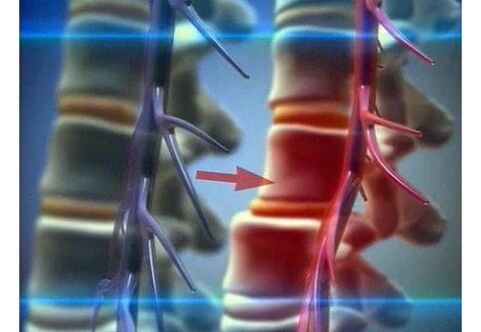
The main alarming symptom of osteonecrosis is pain in the lumbar region.In the early stages, it is localized and directed towards the sacrum, with a pulling (painful) nature.During this period, the destructive process affects the nucleus pulposus (its dehydration occurs), as well as the intervertebral discs (their vertical height decreases).Discomfort is observed when carrying heavy weight, and the pain itself is mild.
After a while, if the problem is ignored and no measures are taken, low back pain begins to spread to the thighs and buttocks.As the space between the vertebrae narrows, the muscles and ligaments “sag” and the spine becomes unstable.This leads to loss of sensation and numbness.
The third stage is characterized by changes in the morphology of the intervertebral disc, the spine itself is severely deformed, the disc protrudes and prolapses.The pain at this stage becomes more intense and lasts longer.Every movement brought unbearable pain.It is possible that the spinal cord areas, blood vessels and nerve endings adjacent to the painful area are compressed due to the protruding fiber ring and affecting the spinal canal.
The final stages of lumbar spondylosis "force" the body to adapt to the changes that occur due to the disease in the following way.To maintain support and protective functions, bone tissue grows in the diseased area.This often leads to various microtraumas and subsequent disability.
An integrated approach to treatment
Treatment of lumbar osteoarthritis must be comprehensive, regardless of the stage of disease development.Mild cases have favorable treatment prognosis;The deformation process can be completely stopped and the consequences can be minimized.At the final stage of the disease, the goal of treatment is to eliminate all symptoms and consequences, normalize the nutrition of spinal tissues and strengthen the muscles of the entire back and its lower part in particular.
Medicine
To relieve pain from lumbar osteoarthritis, painkillers are used in pill or injection form;The second option is preferable because it is more efficient.To reduce the inflammatory process, anti-inflammatory (non-steroidal) drugs are prescribed.Muscle spasms that occur simultaneously with pain will be eliminated with muscle relaxants.Chondroprotectors are used to restore damaged cartilage tissue.
All of the above remedies sometimes do not bring the desired effect, because the damage prevents the drug from penetrating the site of action.
To alleviate acute pain, blockade is used.It should only be done by a professional.
An appropriate analgesic is injected into the space located between the spinous processes using a long needle.After performing this procedure, the pain will disappear very quickly but only for a while because there is no treatment effect.
The local use of complex products - ointments, gels - is effective.They have analgesic, anti-inflammatory, warming effects;Many topical preparations contain chondroprotectants.These remedies, when used properly and combined with massage, will be quite effective.
Physical therapy procedures
In combination with drug treatment for lumbar osteoarthritis, physiotherapeutic procedures are used - bath therapy, laser and magnetic therapy, treatment with weak electric currents, light and vibration.They have virtually no side effects or contraindications.
Alternative method
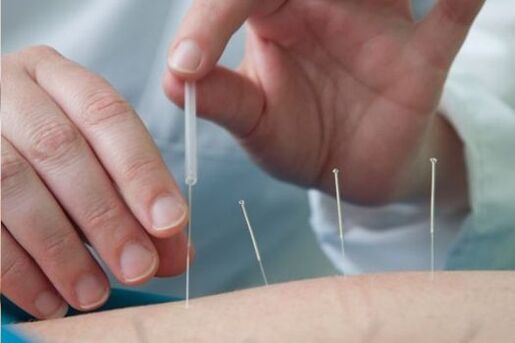
More and more alternative (non-traditional) methods are used simultaneously with traditional treatments - hirudotherapy, acupuncture, bee stings, manual therapy.These methods bring long-awaited pain relief, but some of them have contraindications, so it is necessary to consult a doctor.
In addition to all the above treatment methods, physiotherapy helps to overcome the disease.Properly distributed load with the necessary intensity will help restore blood circulation in damaged areas, form or strengthen the muscle corset, and thereby reduce the load on the spine.
When treating osteoarthritis, it is important to properly combine treatment methods, first of all to relieve acute pain, then inflammatory processes, and only when the acute phase of the disease ends can non-traditional methods and physical exercises be used.
The Yoga and Pilates complex has proven itself to be an excellent rehabilitation program for diseases of the spine.
Lumbar spinal herniation
Against the background of untreated or ignored osteoarthritis of the lumbar region, hernias very often develop - a disease in which due to insufficient physical activity or excessive stress, nutrition of the intervertebral disc tissue occurs, its strength is reduced and, as a result, the disc ruptures.The destructive process can last for many years and go unnoticed throughout this time, but with just one unsuccessful movement, the mechanism begins and all the symptoms begin to appear one after another.
General symptoms and progression of the disease
Symptoms of lumbar herniation include decreased tendon reflexes, pain of varying intensity, muscle weakness, and limb numbness.Pain from hernia does not always occur;There may be low back pain, gradually spreading in the direction of the pinched nerve.
Body deformity is a characteristic sign of lumbar hernia.This phenomenon occurs unintentionally, because the body needs to find the most comfortable position with the least pain.In cases of severe, rapidly progressing disease, the consequence may be paralysis of the lower limbs (partial or complete).This phenomenon is often accompanied by dysfunction of abdominal organs, especially the intestines and bladder.
Clinical manifestations of lumbosacral hernia are manifested by a constant increase in pain and intensification during specific physical activities (lifting weights, bending, sudden strong muscle tension, coughing), dull aching pain localized at one point that does not go away, pain direction in the buttocks or legs, or numbness in this area.
Diagnosis of lumbar disc herniation
It is difficult to diagnose a hernia with the naked eye or solely based on the symptoms the patient describes.To more accurately determine the presence of disease, several methods are used to help pinpoint the exact location of the disease.Computed tomography, nuclear magnetometry and X-ray - thanks to these methods, the doctor will clearly determine the location of pathologically changed vertebrae and see deformed discs.
To determine the severity of the disease and its consequences, doctors use several tests: straightening the leg, tendon reflexes, sensitivity (reaction) of the leg at all levels (from the toes to the hip joint) to certain types of stimuli - pain, vibration and temperature.
Treatment methods
Depending on the severity and condition of the patient, different hernia treatment methods are applied.In case of an exacerbation, first of all, you need to immediately limit physical activity until bed rest and pain relief with medication.After 5-7 days, when the acute period ends and the pain subsides, drug treatment is supplemented with other rehabilitation procedures (massage, physiotherapy, physical education).
Medical and conservative treatment of lumbar hernia is the same as treatment of osteoarthritis.
Surgery
In cases where the disease is severe and leaves serious consequences, surgical treatment is recommended.
Indications for surgical intervention:
- herniated isolation - penetration of the disc area damaged by herniation into the spinal canal;
- dysfunction of all or one organ in the pelvis;
- impaired spinal canal patency (determined by MRI);
- lack of results when using medication and conservative treatment for three months or more;
- sciatic nerve inflammation.
Hernia surgery is currently performed using gentle, minimally invasive endoscopic procedures.
The laser resurfacing method involves evaporating liquid from the protruding nucleus using a laser.Thanks to this, the nerve root is "released", that is, its compression is removed.But this type of intervention has some contraindications such as early spine surgery, spondylolisthesis, ankylosing spondylitis, spinal canal obstruction (stenosis) and nucleus pulposus protrusion into the spinal canal.
To remove the damaged portion of the disc, percutaneous discectomy is used.Vaporization and removal of damaged tissue is performed using a needle that penetrates the skin.
In cases where the damaged disc cannot be restored by any method, starting with medication and ending with minimally invasive surgery, or all used methods fail, the deformed disc will be replaced with a prosthetic disc.
preventive measures
To stop the progression of the disease, special exercises are prescribed.Exercise sets must be individually developed for each patient by a specialist and must include stretching, stretching and light aerobic exercises.
In cases of lumbar spinal herniation, doctors recommend wearing a special fixation belt.Outwardly, it resembles a capsule, about 30 cm wide, attached to the body with Velcro and has several degrees of stiffness.
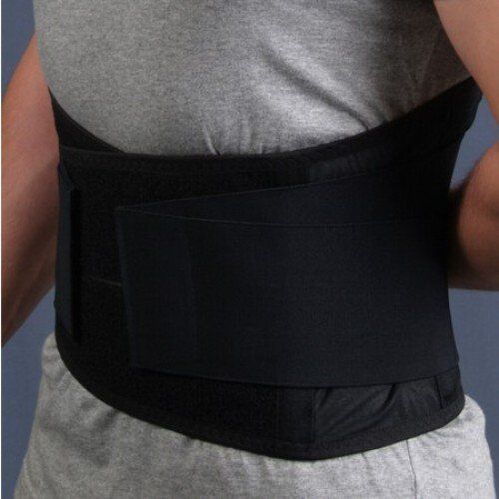
This product is needed to evenly distribute the load (from diseased areas to healthy areas) and reduce tension (unloading).With continuous wearing of the belt, the injured spinal segments will be adjusted and returned to their anatomical position.
Low back pain with radicular syndrome
Against the background of osteoarthritis and herniation of the lumbar spine, low back pain develops as a result - lumbago (acute paroxysmal pain).This is the “simplest” scenario.Since herniation and osteonecrosis are characterized by frequent deformation and prolapse of the damaged disc and displacement of the spine, compression of nearby nerve roots, known as nerve root syndrome, may be observed.
It is enhanced by compression of the veins, causing swelling of the (tender) tissues and congestion.The symptoms of low back pain with nerve root syndrome are similar to the symptoms of lumbar herniation (sharp pain spreading downward, loss of sensitivity and impaired reflexes), and because this is a consequence, the cause must initially be treated with a comprehensive method, otherwise it may lead to disability.
sciatica
Another consequence of hernia and osteoarthritis is inflammation of the sciatic nerve - sciatica and is accompanied by pain that radiates to the legs or buttocks.Although it is possible to clearly identify the "pain" area, the cause lies in the spine.
Sciatica is not an independent disease;This term refers to a number of symptoms that accompany certain spinal diseases.The pain can be different, in some cases it is just a mild discomfort when staying in the same uncomfortable position for a long time, sometimes the pain leads to loss of consciousness and painkillers do not help in this case.
For effective treatment, a diagnosis of sciatica or low back pain is not enough;In any case, you need to conduct a full comprehensive examination from different specialists and accurately determine the cause, since it is the provoking factor.By eliminating just some of the symptoms, the likelihood of the underlying disease progressing and more complications occurring increases.Paying attention to your health, recognizing problems early and getting timely treatment is the key to good health.